Locally made
China’s Decorative Veneer Plywood industry sits at the intersection of design, engineering, and responsible forestry. FAOSTAT production data and the ITTO Biennial Review identify China as a leading global plywood manufacturing center. Its factories serve furniture, interior doors, wall panels, hospitality projects, and custom cabinetry. Yet production volume alone proves little. Buyers must inspect veneer matching, core construction, formaldehyde emissions, moisture resistance, sanding quality, and batch consistency.
Grand View Research continues to report strong demand for wood-based panels, supported by urban construction, renovation, and furniture consumption. However, decorative plywood is not a single uniform product. A walnut-faced panel for a hotel lobby needs different performance controls than a birch panel used for cabinet interiors. Small details matter. Veneer thickness matters. Press temperature matters. So does the adhesive system.
Dr. Rupert Wimmer, a respected wood-science researcher at BOKU University, has stated, “Wood is a renewable material, but not an unlimited material.” That reminder should shape every supplier evaluation. Responsible manufacturers should explain timber sourcing, product testing, emissions documentation, and quality-control procedures. They should also provide clear samples, not only attractive catalog photographs.
This guide examines top Decorative Veneer Plywood manufacturers in China through practical purchasing criteria. It considers manufacturing capability, surface quality, certification, customization, export experience, and communication reliability. Some rankings may remain imperfect because factory data changes, certifications expire, and public information is uneven. That uncertainty deserves attention. A polished panel can hide a weak core. A low quotation can conceal costly rework. Reliable comparison requires evidence, not impressive claims.
What Is Decorative Veneer Plywood?
Decorative veneer plywood is an engineered panel with thin, real-wood veneers bonded over a cross-laminated plywood core. The visible face provides color, grain, and texture. The core supplies strength and dimensional stability. Unlike printed boards, its grain is natural and varies from sheet to sheet. That variation is part of its value.
The FAO Forestry Production and Trade database recorded global plywood production at about 190 million cubic metres in 2022. Its 2022 Yearbook also shows Asia producing more than 60% of global wood-based panels. This explains China’s strong manufacturing capacity, but volume alone does not prove quality. A reliable producer should control veneer moisture, adhesive spreading, pressing temperature, and panel thickness. Small errors can cause bubbling, open joints, or uneven sanding.
Buyers should inspect the face veneer, core gaps, bonding strength, and formaldehyde documentation. The UNECE/FAO Forest Products Annual Market Review identifies housing and renovation as major drivers of panel demand. Yet decorative plywood is not automatically suitable for wet locations. Species, coating, edge sealing, and tested exposure class all matter. The boundary between “premium” and merely attractive can be unclear. That deserves careful checking.
China’s decorative veneer plywood begins with carefully selected logs, often birch, poplar, eucalyptus, or mixed hardwood species. According to FAO’s Global Forest Products Facts and Figures 2023, China produces more than half of the world’s wood-based panels. This scale supports specialized veneer peeling, drying, grading, and panel pressing facilities.
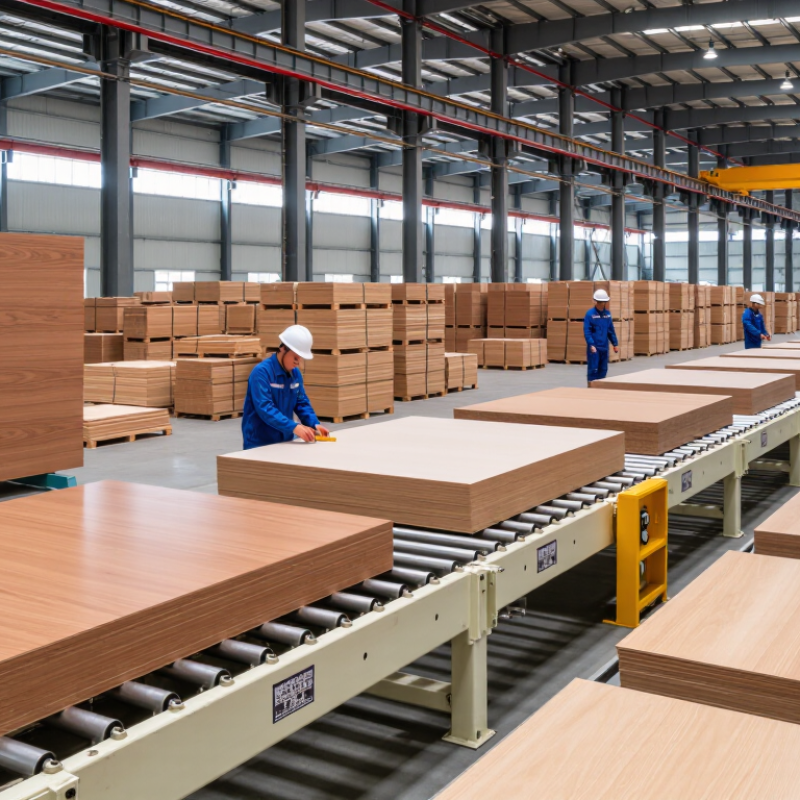
Manufacturing starts when rotary-cut or sliced veneers are dried to roughly 6–12% moisture. Operators then remove defects, match grain direction, and assemble the face veneer over a plywood core. Adhesive is applied in controlled amounts before hot pressing, commonly around 110–140°C. Pressing time depends on thickness, resin type, and panel density. After cooling, panels are sanded, trimmed, and checked for delamination, thickness tolerance, surface defects, and formaldehyde emissions. Testing may reference ISO 12460-5, EN 717-1, or destination-market requirements. A glossy surface can mislead. Weak bonding may remain hidden.
Tips: Request production records, veneer moisture results, and recent laboratory reports. Do not judge quality from photographs alone. Check whether the decorative layer is natural veneer or engineered veneer. Ask for core construction details, adhesive classification, and emission test methods. “E0” is not a universal legal grade, so its meaning should be verified against the destination standard. Factory consistency also deserves attention; one attractive sample cannot represent every batch. Mistakes still occur, especially when drying control changes between seasons. Clear inspection criteria reduce that risk.
Evaluating Chinese decorative veneer plywood manufacturers requires more than inspecting a polished sample. FAO’s Forestry Production and Trade database identifies China as the world’s largest wood-based panel producer, so production scale alone proves little. Request factory audit records, plywood grading procedures, and batch-level test reports. Reliable suppliers should explain veneer species, core composition, moisture content, and pressing temperature. Ask for independent verification under ISO 12465, which specifies requirements for plywood performance and manufacturing quality.
Formaldehyde control deserves close attention. EN 717-1 sets the E1 emission threshold at 0.124 mg/m³, while U.S. TSCA Title VI limits hardwood plywood emissions to 0.05 ppm. These figures are not interchangeable. A credible manufacturer should state the testing method, laboratory, sample date, and applicable market. FSC or PEFC chain-of-custody certification can strengthen claims about responsible wood sourcing, but certification does not guarantee perfect surface quality. Inspect veneer joins under angled light. Check thickness at several points, not one edge. Small gaps often appear after machining.
Factory experience matters. Ask for recent production samples, rejected-panel records, and corrective-action reports. This may feel intrusive, yet transparent factories usually document recurring defects. One weakness remains easy to miss: laboratory results represent tested batches, not every shipment. Buyers should therefore arrange pre-shipment inspection and retain sealed reference samples. Even careful evaluations can fail when humidity, adhesive storage, or transport conditions change. That limitation deserves honest consideration.
| Evaluation Dimension | What to Verify | Relevant Standard or Regulation | Practical Benchmark | Priority | Recommended Evidence |
|---|---|---|---|---|---|
| Product Classification | Confirm whether the product is decorative veneer plywood, including the substrate plywood, natural or reconstructed veneer, backer, and surface finish. | GB/T 15104; GB/T 9846 | The product specification should clearly state panel structure, veneer species or type, grade, thickness, and intended application. | High | Technical data sheet, product drawings, grade declaration, and sample approval record. |
| Raw-Material Traceability | Evaluate the source, species, moisture condition, storage method, and grading process for face veneer, core veneer, and backer materials. | FSC Chain of Custody, where applicable; applicable national timber regulations | Material batches should be identifiable from incoming inspection through production and final shipment. | High | Supplier records, batch numbers, timber legality documents, and incoming inspection reports. |
| Panel Construction | Check veneer lay-up, core balance, symmetry, number of plies, thickness tolerance, and risk of delamination or warping. | GB/T 9846; EN 315 for dimensional tolerances, where applicable | Panels should have balanced construction, consistent thickness, tight joints, and no visible core gaps or open delamination. | High | Cross-section samples, production specifications, thickness test records, and inspection photographs. |
| Bonding Performance | Verify adhesive type, spread control, pressing parameters, curing conditions, and resistance to delamination under the intended service environment. | EN 314-2; EN 636; GB/T 17657 | Bonding class should match the application, such as dry interior, humid interior, or exterior exposure. | High | Adhesive technical data, press logs, bond-strength results, and formal test reports. |
| Formaldehyde Emissions | Assess emissions from the finished panel and confirm the test method and market-specific compliance category. | CARB Phase 2; EPA TSCA Title VI; EN 717-1; GB/T 39600 | For the United States, documentation should demonstrate compliance with CARB Phase 2 or EPA TSCA Title VI requirements. For Europe, verify the applicable emission classification and project specification. | High | Accredited laboratory report, mill certificate, production-batch traceability, and compliance declaration. |
| Surface Appearance | Review veneer matching, color consistency, figure, open knots, mineral streaks, patches, splits, surface defects, and repair quality. | GB/T 15104; buyer-approved visual grading specification | A signed visual standard should define acceptable defects, repair limits, veneer matching direction, and inspection distance and lighting. | High | Approved master sample, defect catalogue, color cards, and pre-shipment inspection report. |
| Dimensional Stability | Measure length, width, thickness, squareness, straightness, moisture content, and resistance to warping after conditioning. | EN 12872; EN 315; GB/T 17657 | Dimensional tolerances and moisture range should be agreed in writing before production and checked by batch. | High | Moisture records, dimensional inspection sheets, conditioning test results, and calibrated equipment records. |
| Mechanical Properties | Verify bending strength, modulus of elasticity, screw-holding performance, surface soundness, and impact resistance when required by the application. | EN 310; EN 12872; GB/T 17657 | Mechanical values should be tested on the actual panel construction rather than inferred only from the wood species. | Medium | Third-party test reports, internal laboratory records, and construction-specific test samples. |
| Moisture and Storage Control | Review kiln-drying, warehouse humidity, pallet protection, edge sealing, and container loading procedures. | Manufacturer quality procedure; project-specific storage requirements | Panels should be protected from rain, ground moisture, and rapid humidity changes during storage and transport. | High | Warehouse records, moisture measurements, packaging specification, loading photographs, and handling instructions. |
| Quality Management System | Determine whether the factory uses documented procedures for purchasing, production control, inspection, nonconformance, corrective action, and change management. | ISO 9001, where certified | A consistent quality system should cover incoming materials, in-process controls, final release, customer complaints, and corrective actions. | High | Valid certificate, audit report, quality manual, inspection forms, and corrective-action records. |
| Factory Testing Capability | Check whether the manufacturer can conduct routine checks for moisture, thickness, bonding, appearance, emissions, and physical properties. | ISO/IEC 17025 for accredited laboratories, where applicable | Routine production tests should be supported by calibrated instruments and a defined sampling plan. | High | Equipment list, calibration certificates, laboratory procedure, sampling plan, and recent test records. |
| Third-Party Certification | Validate certificates for legality, chain of custody, emissions, fire performance, or other claims relevant to the destination market. | FSC; CARB; EPA TSCA Title VI; CE marking under EN 13986, where applicable | Certificates should be current, issued to the correct legal entity, and applicable to the specific product or production site. | High | Certificate copy, certification scope, certificate number, issuing body, validity date, and production-site details. |
| Production Capacity | Assess veneer drying capacity, hot-press capacity, sanding and finishing lines, monthly output, and ability to maintain quality during peak orders. | Buyer qualification requirement | Capacity claims should be supported by equipment data, production schedules, and historical delivery performance rather than stated volume alone. | Medium | Factory audit, equipment list, production plan, capacity calculation, and shipment history. |
| Customization Capability | Review the ability to produce requested species, veneer matching, panel dimensions, thicknesses, finishes, edge treatments, and packaging formats. | Approved technical specification and golden sample | All custom requirements should be converted into measurable tolerances and approved before mass production. | Medium | Prototype panels, signed samples, production drawings, tolerance sheet, and change-control records. |
| Export and Packaging Control | Evaluate export experience, pallet design, moisture barriers, corner protection, labeling, container utilization, and documentation accuracy. | ISPM 15 for regulated wood packaging; destination-country import requirements | Packaging should prevent abrasion, edge damage, water exposure, and movement during multimodal transportation. | High | Packaging specification, loading plan, shipping marks, packing list, and previous transport claim records. |
| Commercial Reliability | Compare lead time, minimum order quantity, payment terms, sample policy, warranty terms, complaint response, and replacement process. | Purchase contract and quality agreement | Commercial terms should define inspection rights, acceptance criteria, claims procedure, and responsibility for nonconforming goods. | High | Quotation, sales contract, quality agreement, service-level commitments, and customer reference checks. |

Note: Standards and certification requirements should be confirmed against the latest edition and the regulations of the destination market before purchase.
Leading decorative veneer plywood manufacturers in China are increasingly judged by measurable quality, not catalogue appearance. FAO Forestry Production and Trade data identifies China as the world’s largest plywood-producing country, supported by extensive panel-processing capacity. However, decorative production demands more than volume. Reliable manufacturers control veneer moisture, core alignment, adhesive spread, and hot-press temperature. A 0.6-millimetre face veneer can reveal defects quickly under bright showroom lighting.
Experienced buyers should request production records and independent test reports. Relevant checks include formaldehyde emissions under EN 717-1, surface bonding strength, moisture resistance, and thickness tolerance. China’s forest-products industry reports have repeatedly highlighted automation, resource efficiency, and product upgrading as major manufacturing trends. These indicators help separate technically capable suppliers from simple trading operations. Still, certification alone is not enough. Factory audits, batch samples, and traceable timber documentation remain necessary.
The sector is not flawless. Veneer colour may differ between batches. Small core gaps can also escape visual inspection. Leading manufacturers usually reduce these risks through digital grading, calibrated sanding, and multi-stage inspection. Buyers should examine a full panel, not only a sample corner. Ask for recent test results. Ask again when specifications change. This practical discipline often reveals more than polished marketing language.
Standards-based comparison of formaldehyde emission limits commonly used for decorative veneer plywood in China.
The chart compares Chinese formaldehyde emission classification limits: ENF, E0, and E1. Lower values indicate stricter emission requirements. Values are shown in milligrams per cubic meter (mg/m³) and are intended as an industry reference rather than company-specific data.
Choosing the right Chinese veneer plywood supplier requires more than comparing prices. The FAO’s Global Forest Products Facts and Figures 2023 reports global wood-based panel production at approximately 375 million cubic metres in 2022. China supplied more than half of that volume, so capacity is rarely the only concern.
Look for suppliers with stable veneer sourcing, documented grading rules, and repeatable pressing records. Ask for recent laboratory reports covering formaldehyde emissions, bonding strength, moisture, and thickness tolerance. Check whether testing follows recognized standards, such as EN 13986, ASTM methods, or applicable Chinese standards. Certifications matter, but verify their scope and expiry date. A certificate for a factory may not cover every product.
Request samples from different production batches. Examine the face veneer under daylight. Watch for open joints, patch marks, bubbling, and uneven color around the edges. Ask for a factory video call or an independent inspection before shipment. The Forest Stewardship Council’s chain-of-custody framework can also help verify responsible material tracking, when relevant to your market.
Price can mislead. Very low offers may reflect thinner veneers, weaker cores, or unrealistic moisture targets. Delivery history matters too. Ask for production lead times, packaging photos, and claims procedures in writing. One weakness remains: supplier documents can look complete while quality varies between batches. A small trial order is often wiser than a large first commitment.